Picking a river cruise in Europe looks easy at first. Then you start comparing. There are lots of rivers, lots of cruise lines, and prices that never seem to include the same things. And this year, news about low water and canceled trips gave people one more thing to worry about.
So let’s make it simple. I’ll walk you through planning a Europe river cruise the same way I do it with my clients. We’ll pick the river first, then the cruise line, then the best time to go. Along the way, I’ll share real prices, what’s included, the downsides nobody mentions, and what to ask about water levels before you book.
Europe River Cruise at a Glance
Here’s the quick version, in case you want the basics before we get into the details.
| What you want to know | Quick answer |
| How long is a typical trip? | Usually 7 nights. Some lines also offer short 3 to 5 night trips. |
| How big are the ships? | Small. Most carry about 100 to 200 guests. |
| What does it cost? | Most 7 to 8 night cruises run about $3,500 to $7,500 per person, or roughly $400 to $1,000 a day. Flights are usually extra. (As of November 2026) |
| When is the season? | Mostly spring through fall, plus Christmas market trips in late November and December. |
| Best months to go | May to June and September to October |
| Most popular rivers | The Danube and the Rhine |
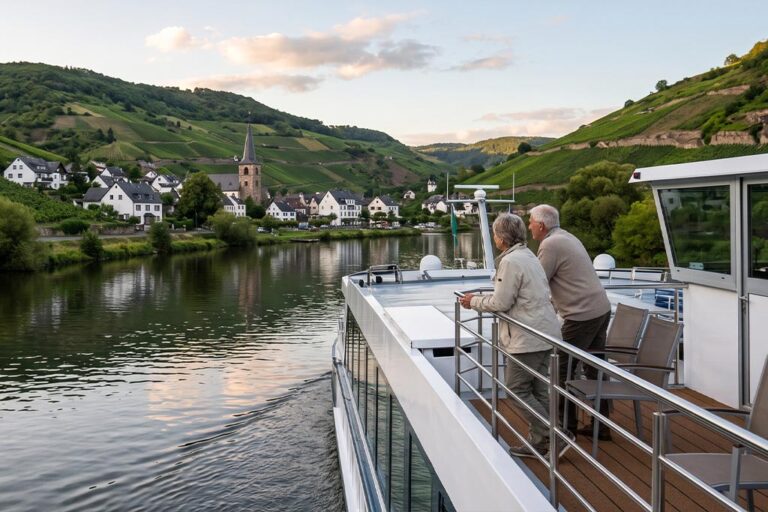
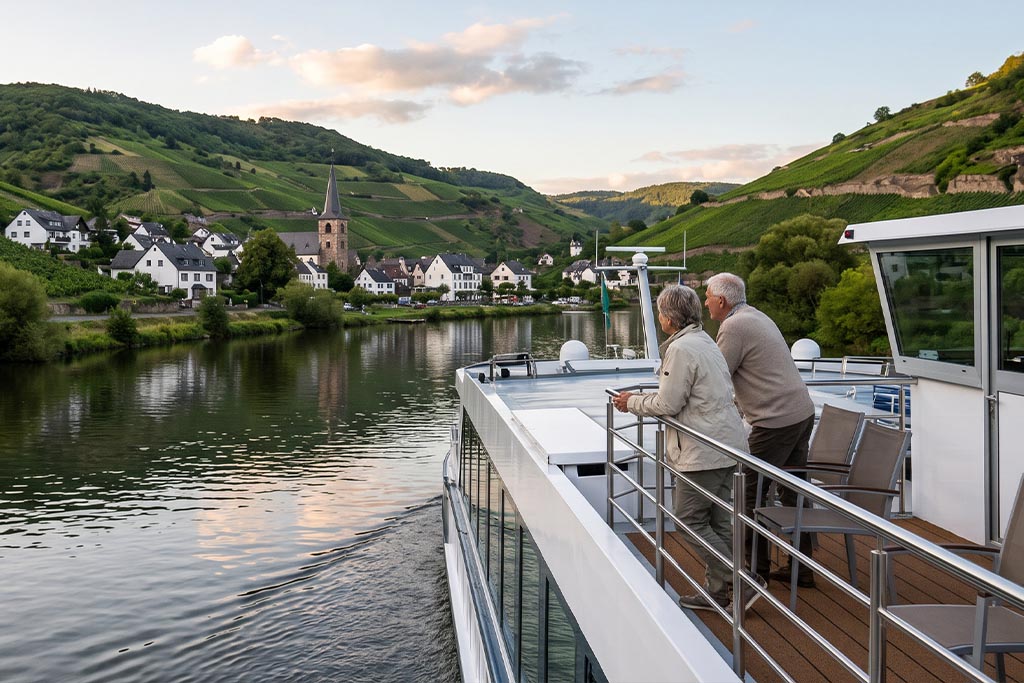
A river cruise is very different from a big ocean cruise. You stop in a new town almost every day, and you’re never far from land, so the views keep changing right outside your window. It’s also not the same as a one-hour boat tour in a city like Paris or Budapest. This is a full trip, with your room, meals, and daily outings all planned for you.
Is a River Cruise in Europe Right for You?
I love river cruises, but I’ll be honest: they aren’t for everyone. Before we talk about rivers and prices, it helps to know if this kind of trip fits the way you like to travel.
Great for First-Timers and Seniors
If you’ve never been to Europe, a river cruise is one of the easiest ways to see it. You unpack once, and the ship takes you to a new town almost every day. Your meals, room, and many tours are already planned, so there’s no hauling suitcases between hotels or figuring out trains.
It’s also a nice fit if you prefer a relaxed pace. The ships are small, so it’s easy to get around and meet people. Just keep a few things in mind. Many tours mean walking on cobblestone streets, some ships have elevators while others only have stairs, and the walkway from the ship to shore can be steep when water levels change. If walking is hard for you, ask about these details before you book.
What About Families?
Most river cruises are made for adults. Viking, for example, only accepts guests who are 18 or older. You’ll find fewer kids’ activities and more history tours and wine tastings.
That said, a few trips are designed just for families. Adventures by Disney runs family river cruises on AmaWaterways ships, with 2027 trips on the Rhine. Tauck also offers family sailings on rivers like the Danube, Rhine, Rhône, Seine, and Douro. These trips fill up early, so plan ahead if you want one.
The Honest Downsides
River cruises can cost more per day than a trip you plan on your own. Cabins are usually smaller than on ocean ships, and evenings are quiet, with no casinos or big shows. Low or high water can also change your plans, which I’ll explain later in this guide.
A river cruise may not be the right choice if you want lots of nightlife, plenty of free time in one city, or a trip with young kids outside the family sailings. But if you want to see several countries without the stress, it’s hard to beat.
Step 1: Choose Your River
When people come to me wanting a European river cruise, I start by asking about the river, not the cruise line. The river shapes everything: the cities you see, the scenery, and even the best time to go. Here’s a simple look at each one, so you can see which fits you best.
Europe River Cruise Map and Routes
If you’re planning a river cruise in Europe, these are the routes you’ll see most often.
| River | Typical route | Usual length | Best for |
| Danube | Passau or Vilshofen to Budapest | 7 nights | First-timers and big-city lovers |
| Rhine | Amsterdam to Basel | 7 nights | Castles and seeing several countries |
| Main and Moselle | Often part of longer Rhine or Danube trips | 7 to 14 nights | Wine country and small towns |
| Seine | Round trip from Paris | 7 nights | Paris, art, and Normandy history |
| Rhône and Saône | Lyon to Provence | 7 nights | Food lovers |
| Bordeaux | Round trip from Bordeaux | 7 nights | Wine lovers |
| Douro | Round trip from Porto | 7 nights | Vineyards and a slower pace |
| Dutch and Belgian waterways | Round trip from Amsterdam | 5 to 7 nights | Spring tulips and shorter trips |
The Danube
The Danube is one of the longest rivers in Europe. It runs about 1,770 miles through 10 countries and passes four capital cities: Vienna, Bratislava, Budapest, and Belgrade. Most trips sail the upper part, between Germany and Budapest. Longer trips continue down the lower Danube toward the Black Sea.
A highlight for many travelers is the Wachau Valley in Austria, with its vineyards, small villages, and hilltop abbey. One quick tip: Prague isn’t on the Danube. Many people add it as a stay before or after the cruise.
The Rhine, Main and Moselle
The Rhine is famous for its castles. The most scenic stretch is the Rhine Gorge in Germany, where old castles sit high above the river. A typical trip runs between Amsterdam and Basel, passing through the Netherlands, Germany, France, and Switzerland.
The Main and Moselle are quieter rivers that connect to the Rhine. The Moselle is known for steep vineyards and charming wine towns. The Main often appears on longer trips that sail all the way from Amsterdam to Budapest.
Danube vs. Rhine: Which Should You Pick First?
These two rivers are the most popular first choices, and both are great. Here’s how they compare.
| Danube | Rhine | |
| Scenery | Wachau Valley vineyards and rolling hills | Castles, the Rhine Gorge, and vineyards |
| Cities | Grand capitals like Vienna and Budapest | Amsterdam, Cologne, Strasbourg, and Basel |
| Countries on a typical trip | Mostly Germany, Austria, Slovakia, and Hungary | The Netherlands, Germany, France, and Switzerland |
| Christmas markets | Yes | Yes |
| Low-water risk | Affected in 2026 | Affected in 2026 |
My simple advice: choose the Danube if you love big, beautiful cities and music. Choose the Rhine if castles and seeing more countries in one week sound exciting.
France, Portugal and the Netherlands
France has three great options. The Seine takes you from Paris to Normandy, with stops near Monet’s gardens and the D-Day beaches. The Rhône and Saône sail from Lyon into Provence, which is perfect if you love food. Bordeaux cruises are all about wine and pretty villages like Saint-Émilion.
In Portugal, the Douro winds through terraced vineyards near Porto. Ships here are often smaller, and prices can run a bit higher. In the Netherlands and Belgium, spring trips are timed for tulip season and are usually shorter. Rivers like the Elbe and Po also offer cruises, but water levels there can be less reliable, so they’re better for experienced cruisers.
Step 2: Choose From the Best River Cruise Lines in Europe
People often ask me which river cruise line is the best. The honest answer is that there’s no single winner. The right line depends on your budget, your travel style, and how much you want included in the price.
How the Main Lines Compare
Here’s a simple overview of the lines I’m asked about most. Inclusions change, so always check the details for your exact sailing.
| Cruise line | Price level | Best for | Good to know |
| Viking | Value | First-timers who want a cultural trip | Adults only (18+). Fewer extras included. |
| CroisiEurope | Value | Budget-minded travelers and French rivers | Also offers small barge trips |
| AmaWaterways | Premium | Active travelers and wine lovers | Known for bike tours and wine-themed sailings. Tips are extra. |
| Avalon Waterways | Premium | Couples who want big views from their room | Known for Panorama Suites. Tips are extra. |
| Emerald Cruises | Premium | Good value with modern ships | Tips are included |
| Uniworld | Luxury | Travelers who love elegant, boutique style | More extras included in the fare |
| Scenic | Luxury | Travelers who want almost everything included | Higher upfront price, fewer surprises |
| Tauck | Luxury | Guided trips and families | Runs family sailings on several rivers |
| Riverside | Luxury | Travelers who want spacious suites | A newer luxury line |
Price levels and inclusions are based on River Cruise Advisor’s pricing guide and each line’s published information, as of November 2026.
Why Some Lines Cost More
The price difference between lines usually comes down to what’s included. Value lines keep the starting price lower, but you’ll often pay extra for drinks outside meals, tips, and some tours. Premium lines include more of these, while luxury lines include almost everything, sometimes even airport transfers.
So when you see one line costing a lot more than another, don’t just compare the starting prices. Add up what each one actually includes. A cheaper fare can end up costing about the same once you add the extras.
What’s New for 2027
Confirmed:
- Celebrity River Cruises launches in August 2027 with two new ships, Celebrity Compass and Celebrity Seeker, sailing the Danube and Rhine on 7-night trips. Its first 2027 sailings reportedly sold out within hours when bookings opened in 2025, so ask about current availability.
- New ships across the industry: the cruise industry group CLIA expects 21 new river ships to launch in 2027, as reported by Cruise Critic. These include AmaWaterways’ AmaRudi on the Danube.
May change:
- New ship dates and itineraries can shift before launch.
If you’re trying to decide which line fits you, I can help you compare them side by side. You can learn more about how I plan cruises and all-inclusive vacations.
How Much Does a Europe River Cruise Cost?
Most 7 to 8 night river cruises in Europe cost about $3,500 to $7,500 per person, which works out to roughly $400 to $1,000 a day. Flights are usually extra. The final price depends on the cruise line, your cabin, the river, and when you travel.
Typical Price Ranges
Here’s a simple way to think about prices, based on River Cruise Advisor’s 2026 pricing guide. All prices are per person, based on two people sharing a cabin, as of November 2026.
| Price level | Per person, per day | What you usually get |
| Value | About $400 to $550 | Room and meals, with fewer extras included |
| Mid-range | About $550 to $800 | Better dining and more tours included |
| Luxury | $800 and up | Almost everything included, often even tips and transfers |
Some short or entry-level trips start below these ranges. At the top end, luxury lines can reach about $10,000 to $11,000 per person for a 7-night cruise. That’s why I always compare what’s included, not just the price you see first.
What’s Included and What Costs Extra
Most lines include your room, all meals, wine or beer with lunch and dinner, Wi-Fi, and at least one guided tour in most ports. What changes from line to line is the extras.
Here’s what may cost more:
- Tips: usually about $15 to $25 per person, per day, on lines that don’t include them
- Drinks: cocktails and premium drinks outside of meals on many value lines
- Flights: usually not included, though some lines offer air deals
- Transfers and hotel nights: often extra unless you book a luxury line or a package
- Optional tours: special excursions beyond the included ones
- Travel insurance: always bought separately
When Prices Are Lowest
The best time to book is usually early. Many lines offer their best deals and the widest cabin choice when new trips first go on sale. You’ll also see strong offers during “wave season,” from January to March, when cruise lines run big promotions.
River Cruise Advisor suggests booking 12 to 18 months ahead if you want the best cabins and discounts. Last-minute Europe river cruise deals do pop up, but you’ll have fewer choices, especially for popular dates and balcony cabins.
Best Time to Take a European River Cruise
The best months for most travelers are May to June and September to October. The weather is usually pleasant, crowds are lighter than in midsummer, and prices tend to be better than at peak times. Most river cruises run from about March or April through October, plus special Christmas market trips in late November and December.
Season by Season
| Season | Weather | Crowds and prices | Good to know |
| Spring (March to May) | Cool to mild | Moderate | Tulip season in the Netherlands. Heavy rain or snowmelt can raise water levels. |
| Early summer (June) | Warm | Busier | A great balance of long days and nice weather |
| Midsummer (July to August) | Hot | Busiest, often highest prices | Late summer brought serious low water in 2026 |
| Fall (September to October) | Mild | Moderate | Wine harvest season. Low water in 2026 lasted into October. |
| December | Cold | Busy around holidays | Christmas markets and festive towns |
If you can be flexible, aim for late May, June, or September. If you have your heart set on late summer, it’s smart to ask how your cruise line handles low water before you book. I’ll cover that in the next section.
Christmas Market Cruises
Christmas market cruises usually sail from late November through December on the Rhine and Danube. You’ll stop in towns like Vienna, Nuremberg, Strasbourg, and Cologne, where the squares fill with lights, wooden stalls, hot spiced wine, and handmade gifts.
Pack warm clothes, because days are short and cold. These trips are also a lovely way to celebrate a birthday or anniversary. If you’re planning a special occasion, take a look at how I plan milestone and bucket-list travel.
Low Water and Cancellations: What to Know Before You Book
Rivers rise and fall with the weather. After a long dry spell, parts of a river can become too shallow for ships. After heavy rain or snowmelt, the water can rise so high that ships can’t fit under bridges. Either way, your trip may change, so it’s worth understanding before you pay a deposit.
What Happens When Rivers Run Low or High
The summer and fall of 2026 were a clear example. Record low water hit both the Rhine and Danube, and cruise lines had to cancel or change sailings. Avalon, for example, cancelled a handful of Danube voyages.
Full cancellations are still rare. More often, the cruise line changes the plan. That can mean swapping you to a sister ship on another stretch of river, taking you by bus to cities the ship can’t reach, or adding hotel nights. Water levels can change quickly, so lines often wait until close to departure to tell guests about changes.
How to Protect Your Trip
Before you book, ask these questions:
- How did this cruise line handle low or high water in 2026?
- Does the line swap ships or use buses when rivers can’t be sailed?
- How and when will I hear about changes to my trip?
- If my trip is changed or cancelled, what refund or credit options apply?
Cruise lines decide compensation case by case, so don’t assume a set policy. If you can, avoid late summer on the Rhine and Danube, since that’s when low water has caused the most problems.
Travel insurance is also worth a close look. Read the exclusions carefully, because a bus ride in place of sailing may not count as a covered event. “Cancel for any reason” coverage costs more and usually has to be bought soon after you book.
Planning Your River Cruise From Florida
Starting from Florida, a river cruise in Europe takes a little extra planning. The good news is that most of it is simple once you know what to expect.
Flights and Arriving Early
Most flights from Florida to Europe leave in the evening and land the next morning. A nonstop flight usually takes about 8 to 10 hours, and connections add more time. Depending on your home airport, you may have a direct option or connect through another U.S. or European city.
I always suggest arriving at least one day before your cruise starts. A delayed flight won’t put your trip at risk, and you’ll get a good night’s sleep before boarding. It’s also a great chance to explore your starting city, like Amsterdam, Budapest, or Paris. If you’d like to add a few extra nights before or after the cruise, I can plan that as part of your custom international travel.
Choosing Your Cabin
River cruise cabins come in a few main types:
- Window cabins sit on the lowest deck. They have high windows near the waterline and are usually the lowest priced.
- French balcony cabins have a large sliding glass door with a railing, but no space to sit outside.
- Full balcony cabins let you step outside and sit with a view.
- Suites offer more space and often extra perks.
Is a balcony worth it? It can be, since the views change all day. But ships sometimes dock side by side, so your view may be another ship for a while. To avoid noise, check the deck plan and skip cabins right next to the engine, the lounge, or under busy public areas.
What to Pack
Pack layers, because mornings on the river can be cool even in summer. Comfortable walking shoes are a must for cobblestone streets and walking tours. A light rain jacket and a European plug adapter are also handy.
Dress on most river cruises is relaxed, so casual, comfortable clothes work well. For Christmas market trips, bring a warm coat, hat, gloves, and waterproof shoes. Before you go, check your passport rules on travel.state.gov.
How I Help You Plan It
Planning a river cruise means making a lot of small choices that add up. I help you match the right river and cruise line to the way you like to travel, and I compare what each option really includes so there are no surprises. I’ll also check how a line has handled water-level changes before you commit.
From there, I can arrange your hotel nights, transfers, and tours so the whole trip fits together. You just tell me what matters most, and I’ll take care of the details.
Frequently Asked Questions
Are there short river cruises in Europe?
Yes. Some lines offer 3 to 5 night trips, especially in the Netherlands and Belgium and on parts of the Rhine and Danube. Most classic river cruises are still 7 nights, but shorter trips are a nice way to try river cruising before booking a longer one.
How many euros should I bring on a river cruise?
You won’t need much cash, since cards are widely accepted in most of Europe. Still, it’s smart to carry a small amount of euros for cafés, markets, restrooms, and small tips on shore. Your cruise line will tell you how tips onboard work.
Can I wear jeans to dinner on a river cruise?
On most river cruises, yes. Dress is usually casual, and nice jeans are fine at dinner. Some lines have a dressier welcome or farewell night, so check your cruise line’s guidelines before you pack.
Do I need travel insurance for a river cruise?
It’s not required, but many travelers buy it because river cruises are booked months ahead and cost a good amount. Compare policies carefully and read what’s covered and what isn’t. For the widest choice of coverage, look into it soon after you book.
Can I add time in Prague or Amsterdam?
Absolutely, and many travelers do. Amsterdam is a common start or end point for Rhine cruises, so adding a couple of nights there is easy. Prague isn’t on the Danube, but it’s a popular stay before or after a Danube trip.
Ready to Plan Your Europe River Cruise?
You now know how to pick your river, compare cruise lines, budget for the real cost, and choose the right time to go. You also know what to ask about water levels before you book. That’s everything you need to plan a Europe river cruise with confidence.
If you’d like help putting it all together, I’d love to hear what you have in mind. Tell me where you’re dreaming of going, and we’ll start planning your river cruise together.